This fall, the Pruzan Art Center features a seasonal and shocking exhibition in the Goldrach Gallery that explores our understanding of—and challenges the multiple meanings of—“the grotesque,” which have expanded and shifted over the centuries from horror, disgust, and ribaldry to caprice, wit, and ornament. The exhibition, Grotesque: Art Beyond Restraint, is curated by Miya Tokumitsu, Donald T. Fallati, and Ruth E. Pachman Curator of the Davison Art Collection.
“I had a feeling this would be really popular, because there is so much wild imagery in the show,” Tokumitsu said. “There's a lot of humor, and a lot of transgressive content, which is always exciting to people.”
Tokumitsu said she can take inspiration from anywhere when she is curating an exhibition, from recent acquisitions to the many wonderful Renaissance works in Wesleyan’s holdings. “’Grotesque’ is a word that people use all the time, and that has contemporary meanings that have drifted quite far from their Renaissance origins,” Tokumitsu explained. “I wanted to encompass all of that, and I really wanted to surprise and delight people in a number of ways.”
The word “grotesque” derives from the Italian grottesche, or, loosely, “things of the grotto.” The grotesque image is one that unsettles by disrupting what we think we know, producing conflicted, emotional reactions in a collision of revulsion and fascination. Over time, numerous artistic movements have found the grotesque useful and steered it in new directions. “There's fear there, but there's also pleasure,” Tokumitsu said. “What are the possibilities of being able to be free of social norms and expectations and behavioral codes that we all adhere to?”
"I really hope that people, when they look at some of these images, are better able to articulate to themselves what they're finding pleasurable and what they're finding disturbing, and why,” Tokumitsu said.
The works of the exhibition are presented in four sections in the gallery, illustrated here with one example of each.
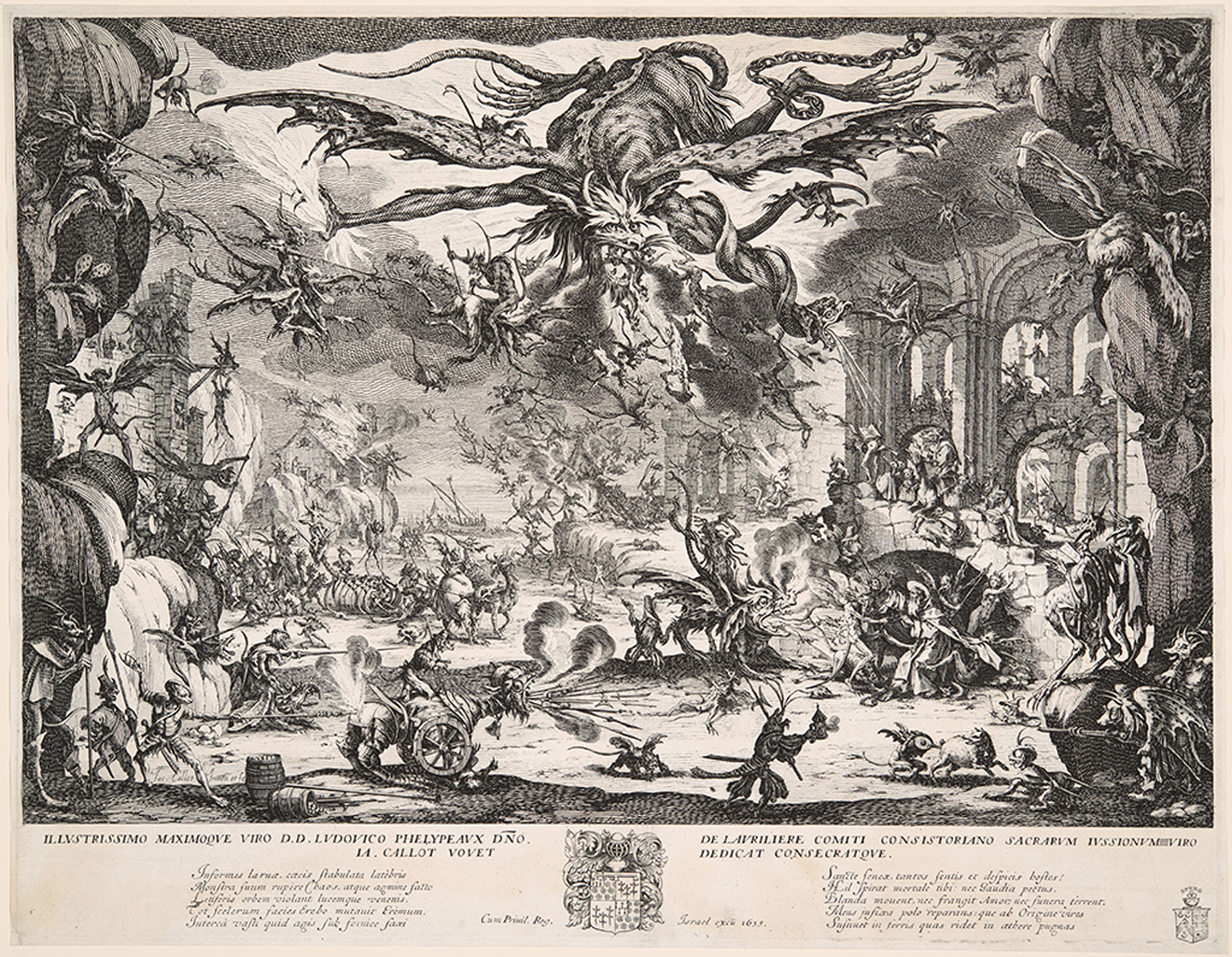
The Dreadful Image
Jacques Callot, “The Temptation of St. Anthony,” 1635, etching. Purchase funds, 1960.14.8. Davison Art Collection, Wesleyan University (photo: M. Johnston).
“There's a whimsy to a lot of these creatures, but then on the other hand, absolutely horrible things are happening all over this chaotic scene,” Tokumitsu said. "Why do you want to look at this horrible stuff? The creatures are so fantastical, all the suffering is abstracted in a way. The imagination of the artist I think is something that people find very interesting and amusing. And I think it's that desire to do the forbidden thing, to engage with the taboo, to look at the thing you're not supposed to look at—there's a real power in that kind of imagery. Callot’s work creates a space where people can engage with all of these desires that that they have.”
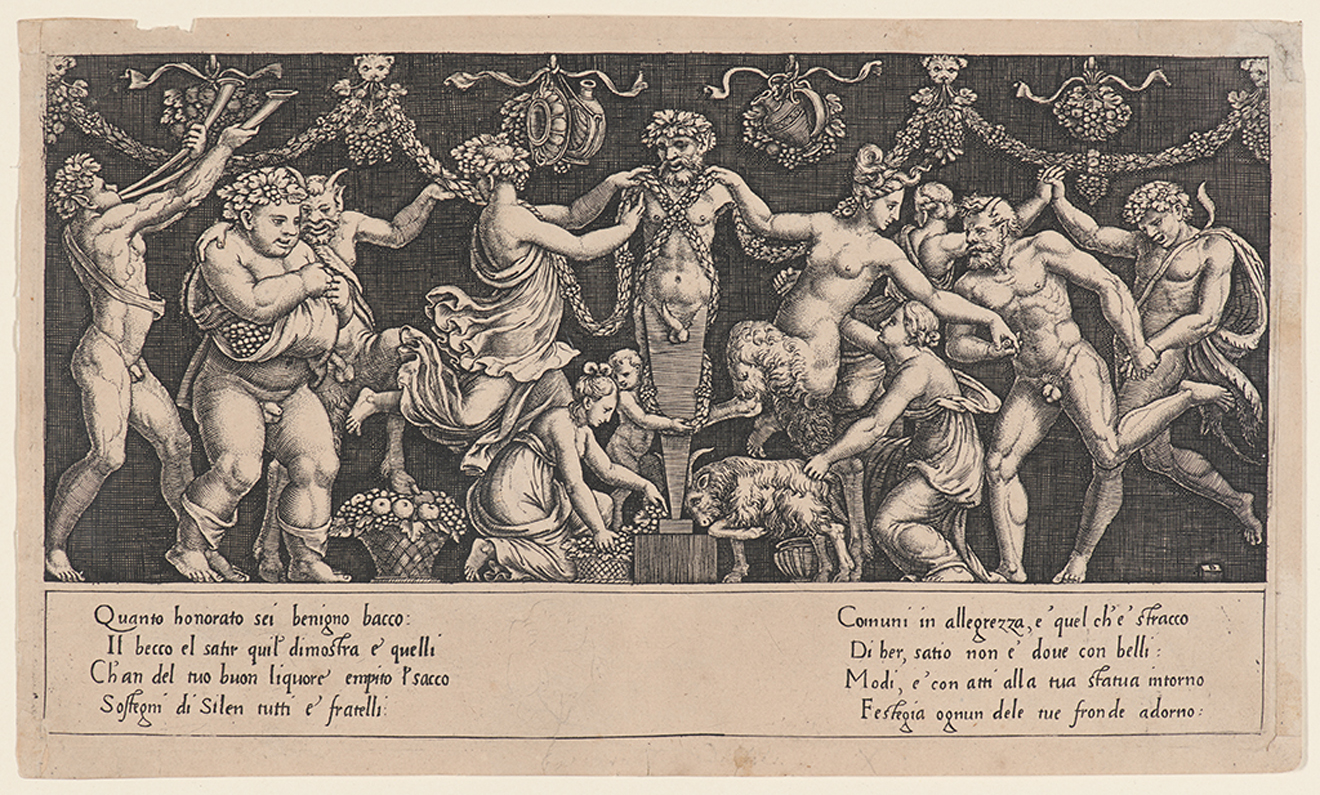
The Licentious Body
Master of the Die, possibly after Raphael or Giulio Romano, “Sacrifice to Priapus,” 16th century, engraving. Gift of George W. Davison (BA Wesleyan 1892), 1952.D1.7a. Davison Art Collection, Wesleyan University (photo: M. Johnston).
“The body is such a fulcrum of grotesque imagery because it evokes these vast, really powerful affective responses that are quite divergent in people,” Tokumitsu said. “The human body is in one sense this ultimate object of desire and longing, but then bodies in reality are often really disgusting and repulsive. The other thing, too, that I think is essential to the grotesque is that bodies are really chaotic. A strand of Renaissance work engages with and acknowledges the grotesque idea that the body is absurd and undignified. It was important to me to include a Renaissance piece that shows the body as very silly and very fun.”
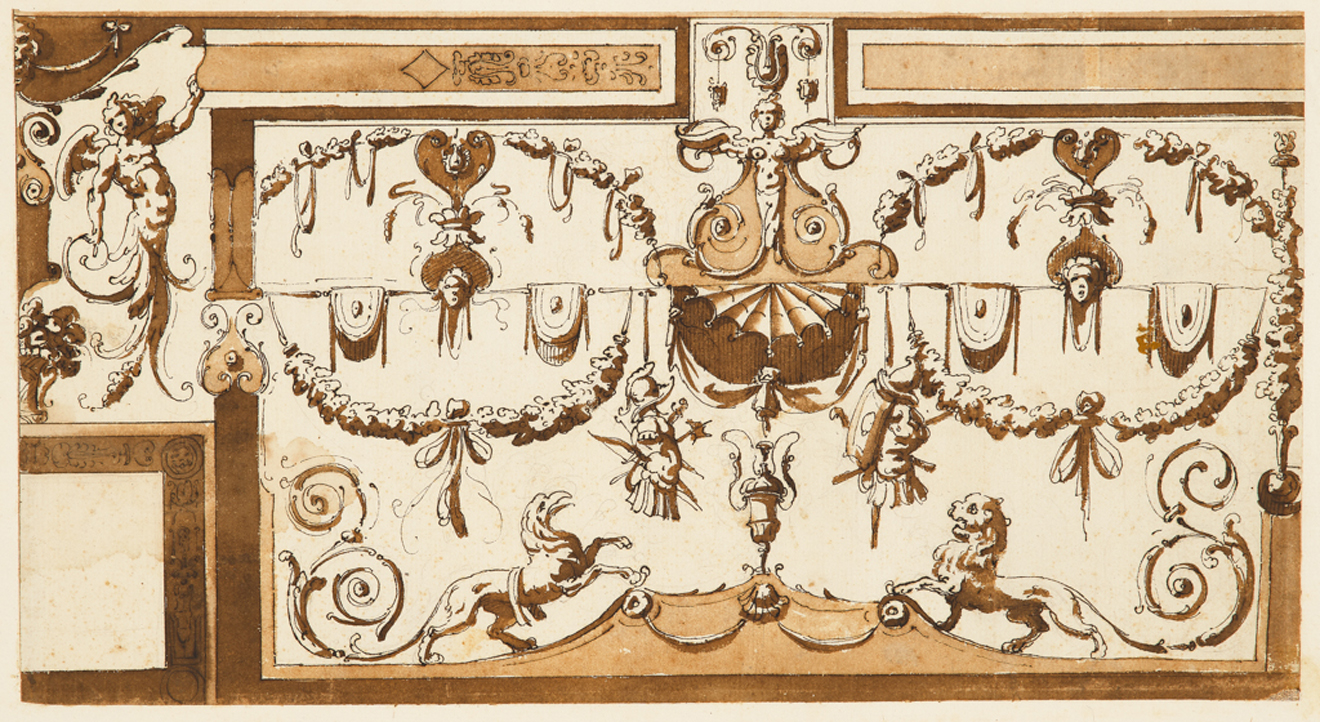
Unidentified Italian artist, Untitled drawing of grotesque ornament panels, mid-16th century, pen and brown ink with brown washes over black chalk. Gift of Nason P. Hamlin, BA 1968, and Erica L. Hamlin, MALS 1991, 2022.1.3. Davison Art Collection, Wesleyan University (photo: J. Giammatteo).
"I think moral objections to ornament are very much still with us," Tokumitsu said. "On the one hand these monsters or these hybrid creatures are so fantastical and wonderful because they are products of pure imagination. People who objected to these Renaissance works had the point of view that this is not just unnatural, but decadent, superfluous, and distracting."
Grotesque: Art Beyond Restraint is on display through Saturday, December 12, 2026.
The Davison Art Collection holds more than 25,000 works of art on paper, including prints, photographs, drawings, and works in other media. A particular strength, the print collection is one of the foremost at a college or university in the United States. The collection supports teaching and learning and was established at Wesleyan University with the founding gifts of George Willets Davison, class of 1892.
Learn more about the Davison Art Collection at wesleyan.edu/dac.