



Skip to Main Content

Drawn Between The Lines

A multi-part exhibition of works made by Wesleyan University students at Cheshire Correctional Institution through Wesleyan’s Center for Prison Education.
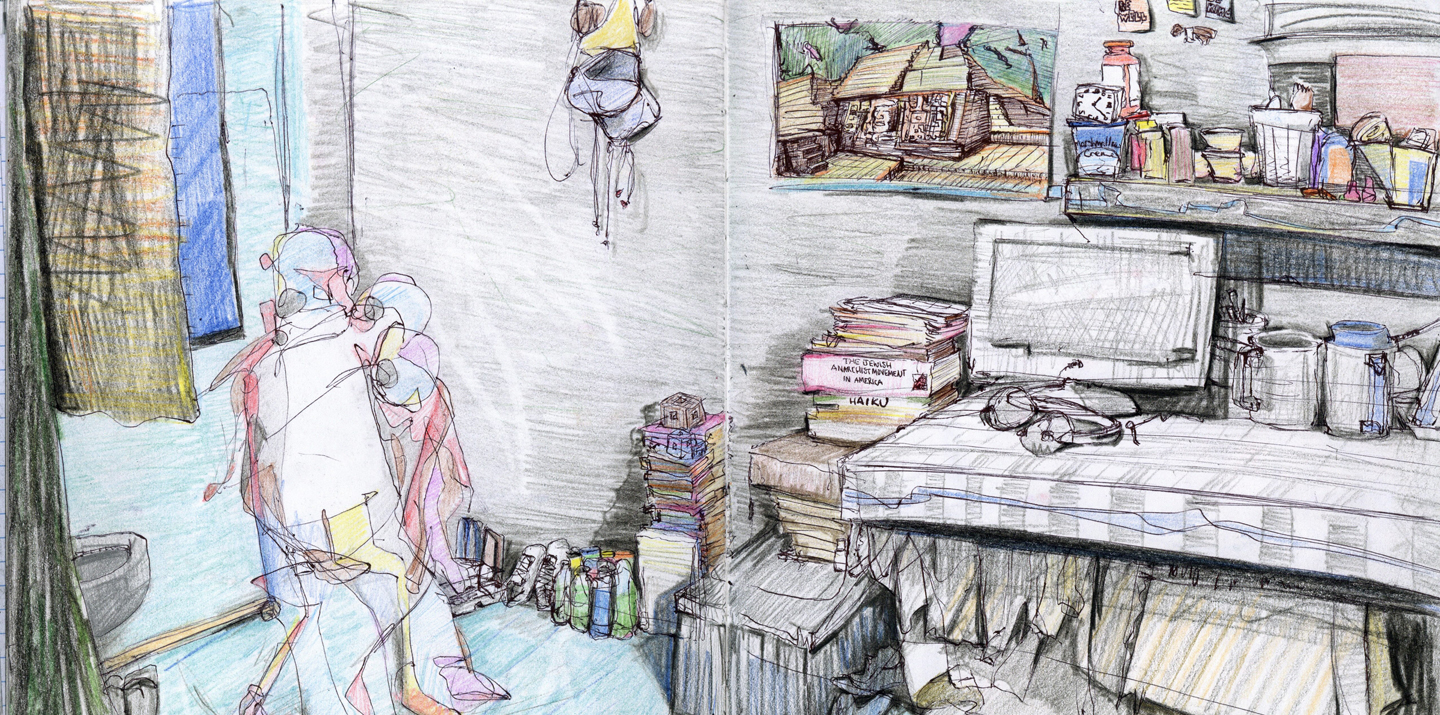
Veronica-May Clark, untitled, 2025. Colored pencil on paper, 11 x 17 inches.

Wednesday, September 30 through Friday, December 4, 2026

Olin Library
252 Church Street, Middletown, Connecticut

Exhibition Overview

Drawn Between The Lines is a multi-part exhibition that brings together a selection of works on paper made by Wesleyan University students enrolled in ARST131 “Drawing I,” taught by Associate Professor of Art Julia Randall, at Cheshire Correctional Institution through Wesleyan’s Center for Prison Education.

Offered for the first time in summer 2025, and again in spring 2026, this was the first college-level drawing course, and the first practice-based arts class (a staple of Wesleyan’s on-campus curriculum), taught at this maximum-security state prison for men. The curriculum was based on the standard “Drawing I” class exercises, including still life and observational drawing, modified by the realities of the context in which the course took place: no live model, no studio access outside the prison classroom, and strict limits on the materials the students could use and observe.

The resulting exhibition—curated by Randall with help from campus student Teaching Assistant Coline McEachern ‘26 —is presented in three sections, installed throughout Olin Library, a hub of student life on campus where many Wesleyan students have the opportunity to exhibit their work through the student exhibition program run by Art History and Visual Arts Librarian Jason Di Resta.

Image: Veronica-May Clark, untitled, 2025. Colored pencil on paper, 11 x 17 inches.

Exhibition Details

The Drawn Between The Lines exhibition will feature three types of student work in Olin Library.
ARST131 “Drawing I” is an introductory course that teaches students to recognize and manipulate fundamental elements of line, mark, tone, shape, sighting/proportion, composition, and spatial translation. Emphasis is placed on working accurately from observation, using a variety of drawing materials and methods to translate the three-dimensional world into pictorial space. At Cheshire Correctional Institution, the course objectives were the same, but the teaching and learning experiences were unique. To study color in an environment defined by cinderblock and tan scrubs, to create depth and practice perspective in spaces limited and monotonously familiar, required looking anew. Alternatively, the "everyday" still life objects introduced to offer a variety of texture and form--squashes, apples, (fake) flowers—were, in this context, entirely rare: forbidden fruits.

Self-Portrait as a Diptych is a selection from the course’s final assignments, in which students created self-portrait diptychs, expanding on traditional ideas of self-portraiture as a singular image to develop a more layered and conceptual representation of the self. For many years, the final assignment for students enrolled in Drawing 1 at Wesleyan has been the creation of a 1:1 self-portrait, a true-scale full body image that requires the use of a full-length mirror. At the prison, the only mirrors available to students were the two-by-four-inch flexible safety mirrors sold on commissary, presenting a layer of challenge to the initial objective observation. The self-image reflected back in these mirrors is slightly dulled and partial. Through the diptych, student-artists brought specular clarity and sharpness to their own image while also thinking creatively about how to represent the complexity of who they are—not just how they appear. The resulting works are an act of reconstruction enacted through the medium of charcoal, graphite, pastel, and ink on paper.

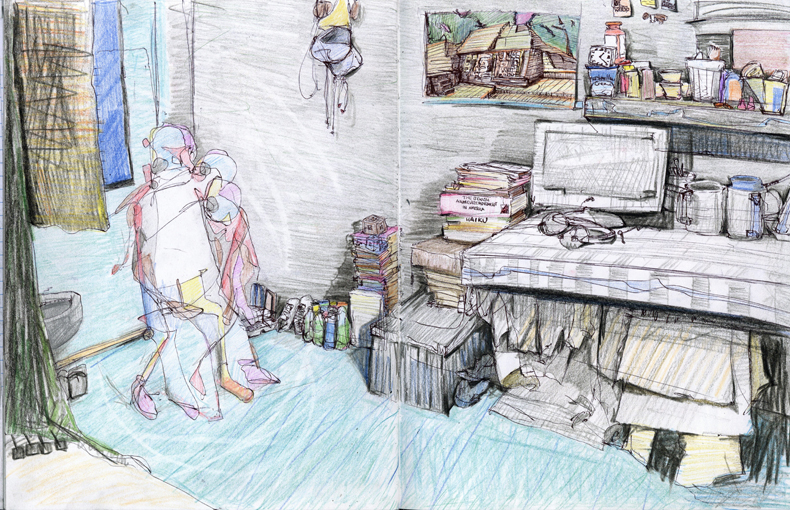
Every other day, students created an entry in their sketchbooks to “document” some part of their lives. This ongoing, semester-long assignment was designed to be open-ended, allowing students to pursue their interests and follow their own observations, with no direction or sense of “correct” subject matter. Documentary in nature, some chose to capture the reality of daily life by capturing the space, people, and activities around them—while others explored internal lives, depicting a range of memories, fantasies, and dreams.