
Global Engagement Expands with Trip to Kenya
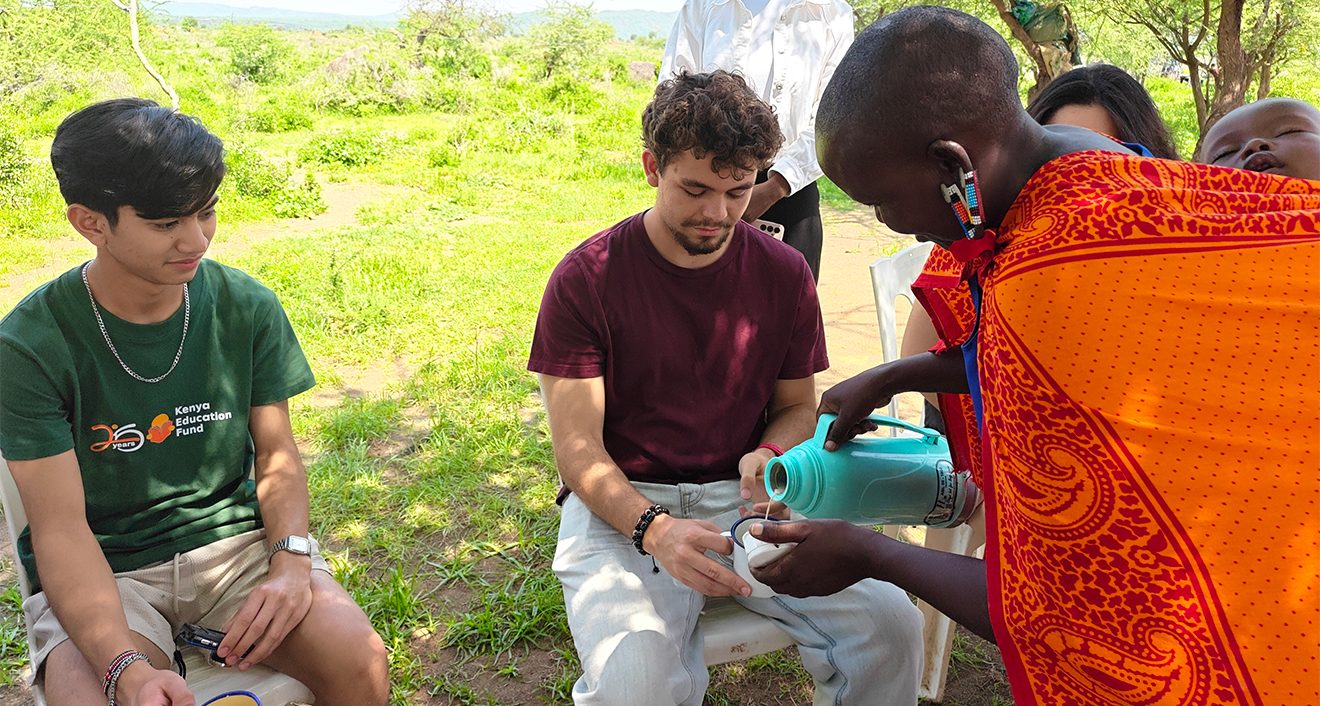
During a 12-day trip to Kenya, a group of Wesleyan students and staff rode a bus chartered by the Kenya Education Fund to a village two hours away from the capital city of Nairobi. They visited with a Maasai family, a traditional ethnic group of semi-nomadic, pastoral people. One purpose of the visit was to meet the family and experience the home of a typical student supported by the fund, which arranged the meeting. The family served their Wesleyan guests fresh goat stew and a medicinal herbal drink while having a conversation translated from Maa, an indigenous language, to Swahili then to English.
It was one of the more memorable moments of the trip for Kaya Waltzer ’26, an Urban Studies University Major minoring in Global Engagement and IDEAS. “All of us students were struck by how many moments and people had to come together for us to end up in this place and to meet this family whose traditional way of life is continuously threatened and devalued around the world in the face of development,” she said. “That was an experience that I was incredibly grateful to have, and I know I'm going to remember their kindness and willingness to share with us for the rest of my life.”
The transformative trip to Kenya was hosted by the Global Engagement Minor in partnership with the fund, which works to provide an education to high school students in the East African country. For Kenyan youth, it was an opportunity to meet and receive mentorship from American students. “Most of what young Kenyans know [about America] is through media and movies, which for the most part is not a true depiction of reality,” said Dominic Muasya, executive director of Kenya Education Fund. “Having Wesleyan students spend one week or more with our students provides an opportunity for cross-cultural exchanges and a better understanding of life on the other side.”
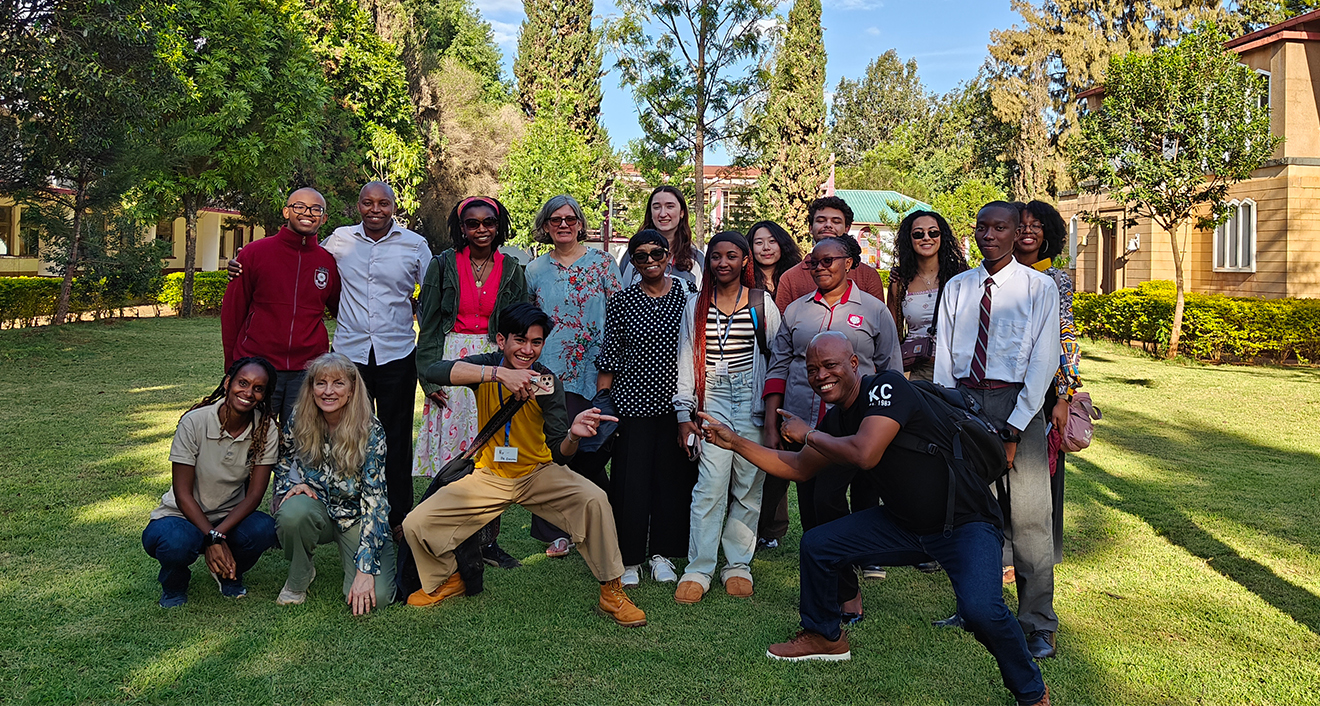
Left to right, top row: Adrian Muasya, Kenya Education Fund (KEF) Executive Director Dom Muasya, Aubrey Piton ’28, Anita Deeg-Carlin, Molly Volker ’26, Anna Li ’28, Isaías Pagan ’26, Kaya Waltzer ’26, Ama Tuffour ’26. Middle row: Willette Burnham-Williams, Lois Amponsah ’27, teacher and student from Lenana School. Front row: Prisca Mutemi, KEF staff, Sabrina Longega (KEF), Ry De Guzman ’28, and Iddrisu Saaka.
For Wesleyan Global Engagement Minor students, it was a chance to have a truly immersive intercultural experience outside of Western Europe, where most students who travel abroad go. The goal of the trip, said Director of Intercultural Learning and Coordinator of the Global Engagement Minor Anita Deeg-Carlin, was to “put the liberal arts into practice by giving students the opportunity to explore their interests and majors in a different cultural context, challenging their viewpoints, and enriching their education in that way.” Deeg-Carlin, who co-teaches the Global Engagement in Practice, Swahili Language and NGO Case Study in Kenya course, co-organized and attended the trip. Professor Kiarie Wa’Njogu, director of the Program of African Languages at Yale, partners with Anita to teach the Swahili language component.
On-the-ground learning
The eight Wesleyan students on the trip arrived in Kenya on March 8, where they first had dinner with their Kenya Education Fund hosts. Over the first few days each student, paired with a fund mentor, helped high schoolers from across the country prepare for university life. The programming included Career Readiness, Reproductive Health, Entrepreneurship Workshops (CREW) and a career panel of fund alumni or affiliates. The adults also engaged the youth in a design-thinking exercise to address a global probelm, ending with a pitch of their solution.
During the afternoons, Wesleyan students participated in a range of activities, including Swahili practice, visits to local public and private schools, and an excursion to SHOFCO (Shining Hope for Communities)—a community-based organization started by Kennedy Odede ’12 that provides health, education, and economic and social services. Wesleyan students also used this time to pursue individual research projects.
Waltzer, who has an interest in public spaces, collaborated with SHOFCO to connect with a girls’ school in Kibera, a settlement often referred to as “the largest slum in Africa.”
She recalled pulling up in an Uber in front of the large concrete building, surrounded by informal settlements. “We'd been told that Kibera was a dangerous place, and we came into this community expecting to see the poverty and desolation that people had described,” said Waltzer. “But throughout our time there with SHOFCO, and especially when I was helping with an art class full of first- and third-grade girls, what I really saw was young people being creative, having fun, and being proud of where they come from.”
The school offers a filmmaking program, coding classes, science experiments, and a rooftop garden where students learn about growing food. Waltzer devoted her time to shadowing an art teacher. “I was interested in how art shapes public spaces in Kibera, where such space is so valuable, and wanted to speak with people who are involved in those creative efforts,” she said. Through her time at the girls’ school, she learned about public art initiatives and how the school was training the next generation of youth to express themselves.
Ama Agyeman Tuffour ’26, a psychology major, focused her project on how cultural identity is shaped by colonization and how colonization is addressed in education systems. Originally from Ghana, Tuffour had done a summer internship with the Ghana Commission for UNESCO (United Nations Educational, Scientific and Cultural Organization), which prompted her to explore her ideas with the Kenyan National Commission for UNESCO.
Tuffour interviewed the UNESCO director about a range of issues, including cultural identity and language, as well as education. While she had engaged with decolonial thinkers in her classes at Wesleyan, the director in Kenya challenged some of her ideas. After experiencing a recent civil war, Kenyans, he said, may want to focus on a national identity and global peace rather than on differences in language and on the past. “The conversation gave me a lot to come back and chew on, which I appreciated,” she said.
The experience provided a different perspective than classroom learning. “At Wesleyan, we all claim to be passionate about topics like equality and decolonization. But learning it on paper and experiencing these things in person or engaging with these topics practically are two entirely different things,” she said. “I think the theoretical knowledge is never complete without having that practical, on-the-ground experience.” Waltzer, Tuffour, and the other global engagement students planned to share what they learned about their projects through a digital portfolio and class presentation.
Lasting impressions
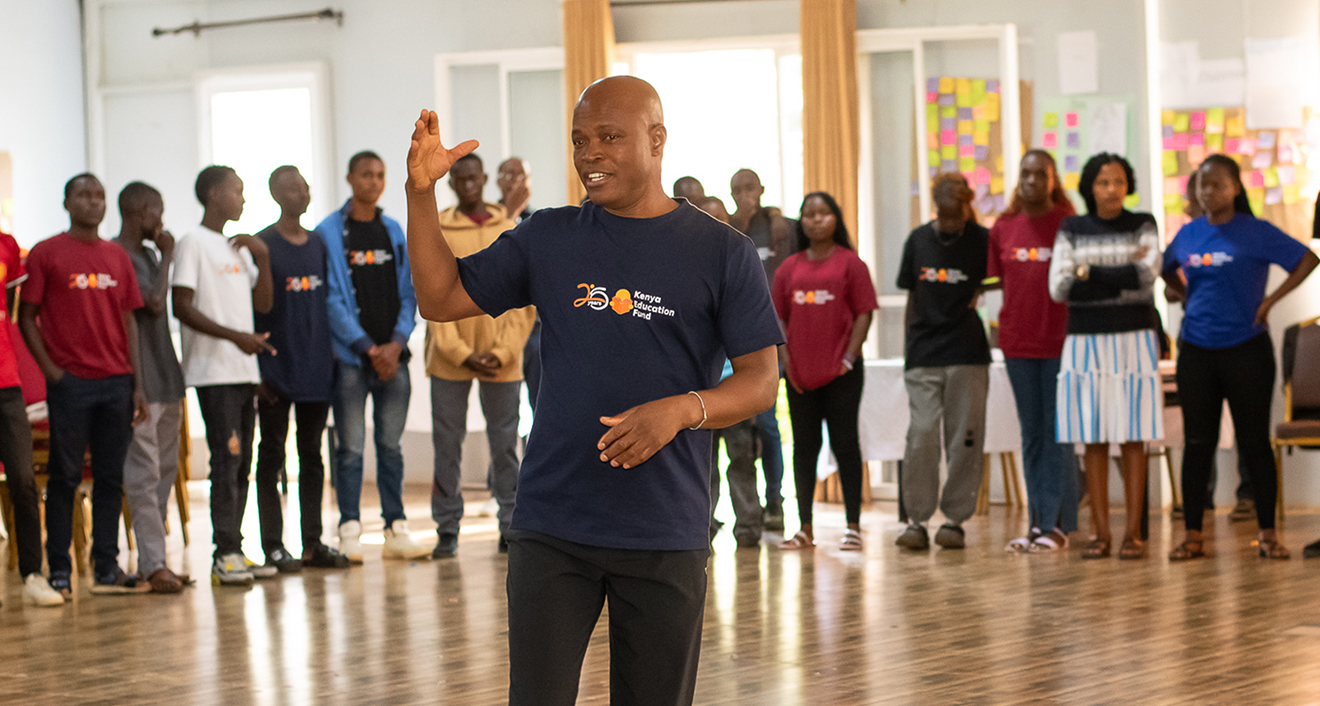
In the final days of the trip, students engaged in a dance workshop lead by the Douglas J. and Midge Bowen Bennet Associate Professor of Dance Iddi Saaka, a dinner with alum Julia Moffett '90, and a visit to a Maasai craft market. Through all of the eye-opening experiences, including sightings of wild zebras and giraffes from the road, a common denominator for students was the personal connections they made. This aspect came up during a debrief on the last day. “When the Kenyan staff asked them what were their most transformational moments, it seemed they all would circle back to the individual relationships that they had made with their Kenyan mentors and the Kenyan students,” said Deeg-Carlin.
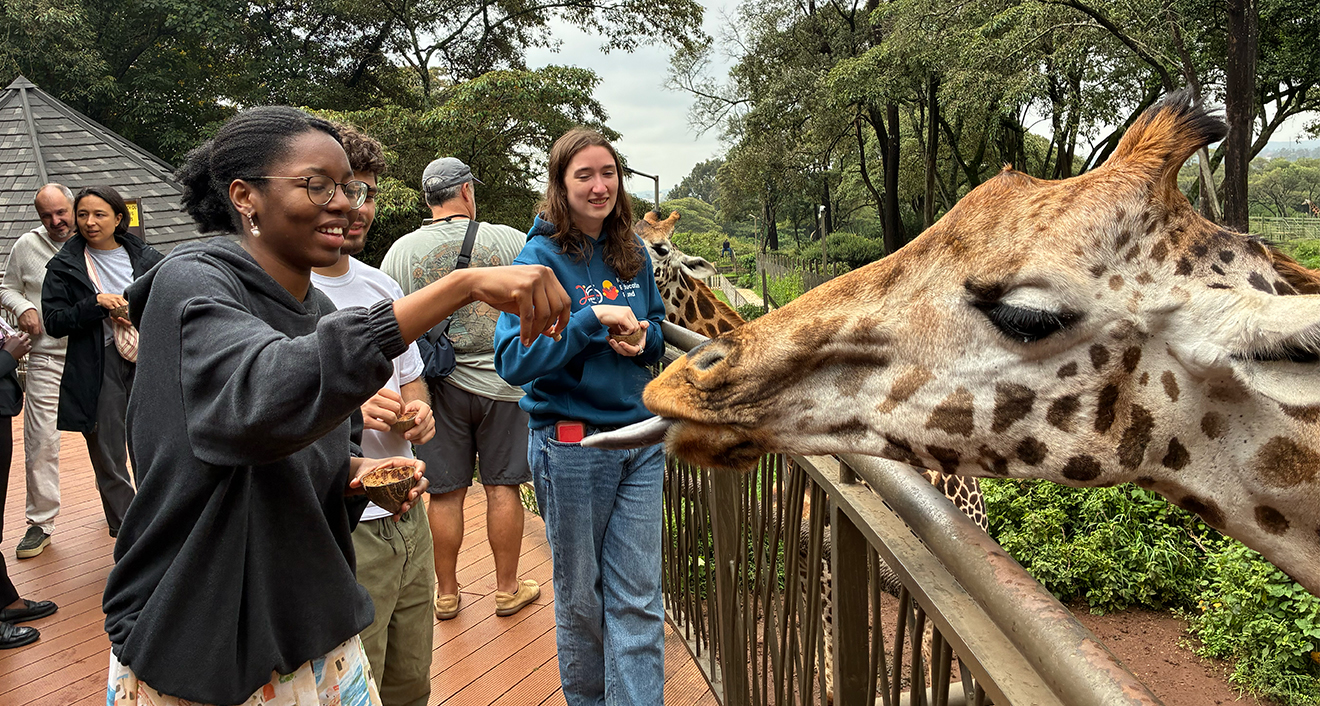
Ama Tuffour ’26, Isaías Pagan ’26 and Molly Volker ’26 feed Salma, a slightly ornery giraffe mama at Nairobi’s Giraffe Center.
Tuffour hopes to stay in touch with her foundation mentor, who she talked to extensively about their respective college experiences. “We spoke a lot about what career paths are encouraged more in different cultural contexts. Overall, I think she was an amazing person to work with,” she said.
Of the trip, Waltzer said, “The entire experience was a really poignant reminder of my own values and what matters to me, which is connecting with people. I really enjoyed meeting and learning from so many Kenyan students and people from backgrounds very different from my own, and I know that I'm going to carry the intercultural lessons I learned from them with me—that no matter what I'm doing in the future, I want it to feel meaningful in a similar way.”
The impact of the trip on both sides of the Atlantic was profound despite its brevity. “You can go abroad for three months and not necessarily challenge your own perspectives,” said Deeg-Carlin. In contrast to typical travel experiences in Western Europe, this visit to Kenya presented a deeply layered experience. “It's such a great way of educating our students and making them better global citizens and problem solvers, quite frankly, because they begin to perceive that people may live by whole different sets of values that we may otherwise take for granted in our studies and work,” she said.
The Kenya trip, which was funded by former trustee Andrew Fairbanks ’90, will repeat again next spring.