Summer 2026 Research Pods
Cell Life & Dev
Mitchel, Tezak, Johnson, and Wirshing labs
At the intersection of cellular and developmental biology lie fascinating questions, such as: how does a cell know what it is, where it is, and what is it's function? How do cells and tissues determine their shapes and architectures, and how does this influence function?
For the 2026 Cell Life & Dev pod, in addition to presenting each lab's current research into these questions, our meetings will be focused on sharing techniques and approaches, with an eye towards opening dialogue and furthering future collaborations.
Computational Design and Manufacturing
Chang-Davidson Lab (Prof. Elizabeth Chang-Davidson), the Textiles Hub (Profs. Sonia Roberts, Yu Nong Khew, Yuxuan Mei)
Groups from across Arts, Computer Science, and CoDES will work on projects that involve design and physical making (including knitting, 3D printing, metal printing). Students and faculty mentors will meet over the summer to talk about experiences working with different machines and manufacturing technologies.
The pod met weekly throughout the summer program.
Esterase 6
Coolon and Taylor Labs
Through combined efforts of fly work, bioinformatics, molecular biology and biochemistry we are seeking to identify the native substrate of Esterase 6 in various Melanogaster species. This effort will aid our understanding of M. sechellia resistance to octanoic acid and may aid in the discovery of insecticides for various insects.
Intelligent Systems and Society (ISS) Pod
Sebastian Zimmeck, Norman Danner, Sonia Roberts, Antonio Laverghetta, David Aaron, Mitali Thakor, Emily Vasquez research groups
The Intelligent Systems and Society (ISS) Research Pod investigates the technical design, legal governance, and societal impacts of emerging autonomous and intelligent technologies. Our pod bridges the gap between technical implementation and humanistic inquiry, bringing together Wesleyan experts from Computer Science, Science and Technology Studies, Robotics, Sociology, and Government.
Our collaborative focus spans intelligent systems from the material design of soft robotic sensors (Sonia Roberts) and the formal analysis of program resource usage and privacy (Norman Danner, Sebastian Zimmeck) to the cognitive alignment of large language models (Antonio Laverghetta). We want to interrogate the "black box" of these technologies via the lenses of national security law and cyber prosecution (David Aaron), the ethical dimensions of companionship (Mitali Thakor), and the socio-political drivers of an emerging technology oligarchy (Emily Vasquez). By integrating these diverse perspectives, the ISS Pod aims to foster a holistic understanding of how technology can be developed and regulated to prioritize privacy, equity, and human well-being in an increasingly automated world.
The ISS Pod held three meetings in June, July, and August. They were open to other interested faculty and students.
The Muscle Nuts
Padilla-Benavides and Feng labs
The Padilla-Benavides and Feng labs both study skeletal muscle physiology. The Padilla-Benavides lab investigates the biological roles of transition metals, including copper (Cu), iron (Fe), zinc (Zn), and manganese (Mn), in mammalian muscle cell biology, with particular emphasis on development, metabolism, and disease. The Padilla-Benavides lab mainly uses mammalian cell culture and mice as model systems. The Feng lab studies skeletal muscle homeostasis in hibernating thirteen-lined ground squirrels, which resist muscle atrophy despite months-long starvation and immobility. The Feng lab uses molecular techniques and behavioral assays to study how muscle morphology and function changes across hibernation. We hope to share ideas and tools to study muscle biology across diverse contexts, including in health, disease, and the extreme physiological states associated with hibernation.
The Muscle Nuts held a combined lab meeting with brunch where students from both labs share updates on their projects.
Planetary Science
Gilmore, Greenwood, Hughes, and Redfield Labs
The Planetary Science group is a long-standing interdisciplinary research group at Wesleyan. Their emphasis is the study of the origin of planetary systems, planetary geology and geochemistry and the application of remote sensing to terrestrial environmental problems. This work incorporates results from observational astronomy, planetary image analyses, and the laboratory and field studies of Earth analogues to other planets.
The pod held a half-day event in July: lunch followed by informal talks from undergraduates, graduates, post-docs, scientists, and faculty on their summer research progress.
Soft & Active Matter @ Wes
Jennifer Mitchel, Francis Starr, Greg Voth, Grace Mackenzie-Smith, Sonia Roberts research groups
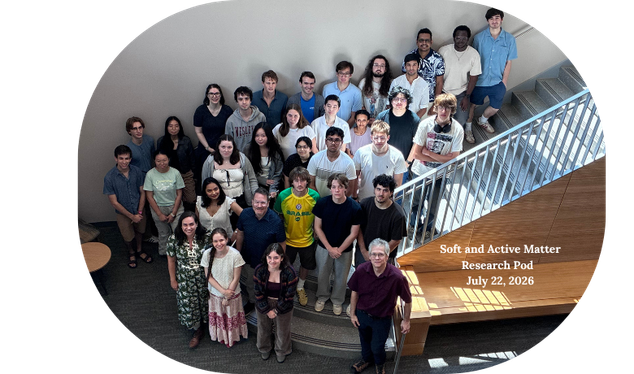
Labs participating in The Soft and Active Matter @ Wes Collective are broadly interested in the emergent behaviors in systems which may be squishy, active, and/or far from equilibrium. Though our individual research focuses on diverse systems, from turbulent flows to insect swarms to migrating cells to molecular glasses, these diverse systems share the feature of exhibiting emergent properties, in which "the whole is more than the sum of its parts".
The pod held a day-long meeting in the Frank Center, open to other interested research groups.
WEaSt
Coolon, Holmes, MacQueen and Weir Labs
The WEaSt ("Wesleyan yeast") meetings were initiated by MB&B professor Amy MacQueen in 2010 and for several years have met two to three times each summer for colleagueship and presentations by students. The meetings provide opportunities for students to present and receive feedback on their projects, gain exposure to new subjects and techniques, and become familiar with a larger community of researchers with overlapping goals and approaches.
On July 21, the WEaSt Pod held a meeting with student presentations followed by a reception.